Ensayos clínicos sobre cannabis y cannabinoides publicados en 2025: Algunos hallazgos notables
En el 2025, se realizaron un número de ensayos clínicos en diversas áreas de interés para el cannabis y los cannabinoides, tanto en aplicaciones clínicas como cuestiones de salud pública. La evidencia derivada de estos ensayos clínicos dibuja un panorama de un campo en transición, que busca responder preguntas tanto de eficacia del uso del cannabis y los cannabinoides, al igual que temas de seguridad, equidad, implementación e impacto en el mundo real. Nos enfocamos en los ensayos controlados, pues esta metodología permite la evaluación rigurosa de la eficacia y seguridad del cannabis y los cannabinoides, proporcionando evidencia de alta calidad que puede orientar la toma de decisiones clínicas y la formulación de políticas. Los ensayos controlados ayudan a aislar los efectos específicos de los cannabinoides de las respuestas al placebo, los sesgos de expectativa y otros factores de confusión, aumentando las posibilidades de que los beneficios o daños observados sean atribuibles de forma fiable a la intervención. Además, las pruebas sistemáticas respaldan la dosificación estandarizada, identifican posibles efectos adversos y fundamentan las evaluaciones de riesgo-beneficio, esenciales para integrar los cannabinoides en la práctica médica basada en la evidencia.
“Los ensayos aleatorios controlados son el estándar de oro para evaluar los efectos de las intervenciones de atención médica, porque nos protegen de nuestros propios sesgos y de los sesgos de los demás.”
Buscando las publicaciones de ensayos clínicos indexadas en PubMed en 2025 que incluyen cannabis o cannabinoides en el título*, encontramos 85 estudios, que ofrecen una visión sobre las áreas de interés para los investigadores Estos ensayos reflejan un campo de investigación que abarca salud mental, salud pública, intervenciones clínicas, ciencia de la seguridad y cuestiones relevantes para políticas públicas.
Una parte considerable de la investigación de ensayos clínicos reciente se centra en la salud mental y el consumo de cannabis, especialmente entre adolescentes y jóvenes adultos. Varios ensayos examinan los vínculos entre el consumo de cannabis, la abstinencia y resultados como depresión, ansiedad y suicidabilidad, a menudo en el contexto del co-consumo con nicotina o alcohol. Estos estudios van cada vez más allá de simples asociaciones para probar intervenciones —tanto conductuales como digitales— destinadas a reducir el daño y mejorar los resultados en la cesación.
Paralelamente, hay un impulso creciente en la investigación en prevención y reducción de daños. Se están evaluando intervenciones escolares y comunitarias centradas en la regulación emocional y la resiliencia, junto con programas adaptados culturalmente para poblaciones diversas. Cabe destacar que los enfoques de salud digital —como las aplicaciones para smartphones, las intervenciones por mensajes de texto y las terapias motivacionales móviles— tienen un papel destacado, reflejando tendencias más amplias en la investigación en salud conductual y la necesidad de llegar a poblaciones de alto riesgo a gran escala.
Otra área activa es el cannabis y el rendimiento al volante, donde estudios aleatorios en simuladores evalúan los efectos del THC, el CBD y sus combinaciones en la capacidad de conducción. Un hallazgo coherente entre los ensayos es la desconexión entre la discapacidad percibida y la real: los participantes a menudo subestiman su nivel de discapacidad, lo que plantea importantes implicaciones para la comunicación y la política de salud pública.
Las etiquetas de advertencia y la comunicación sanitaria son un foco de investigación en crecimiento. Varios ensayos exploran cómo diferentes formatos —advertencias de texto, pictogramas o imágenes vívidas— afectan la atención, la memoria y la percepción del riesgo, especialmente entre adultos jóvenes. Estos estudios subrayan que no todas las advertencias son igual de efectivas y que la resistencia del consumidor o la normalización del riesgo sigue siendo un desafío.
Investigaciones clínicas.
En el ámbito clínico, el cannabidiol (CBD) sigue dominando la investigación terapéutica. La evidencia más sólida y consistente surge en la epilepsia resistente al tratamiento, donde los ensayos de fase 3 y los estudios de extensión a largo plazo demuestran reducciones sostenidas de las convulsiones y un perfil de seguridad generalmente manejable. Más allá de la epilepsia, los ensayos investigan cannabinoides para el dolor crónico, síntomas relacionados con el cáncer, trastornos neurológicos (incluyendo la enfermedad de Parkinson, esclerosis múltiple, síndrome de Tourette y X frágil), trastornos del sueño y afecciones inflamatorias o musculoesqueléticas. Los resultados suelen ser mixtos: algunos estudios muestran beneficios modestos en el dolor, la espasticidad o síntomas específicos, mientras que otros no encuentran mejoría significativa en comparación con el placebo, lo que pone de manifiesto la necesidad de indicaciones y estrategias de dosificación más precisas.
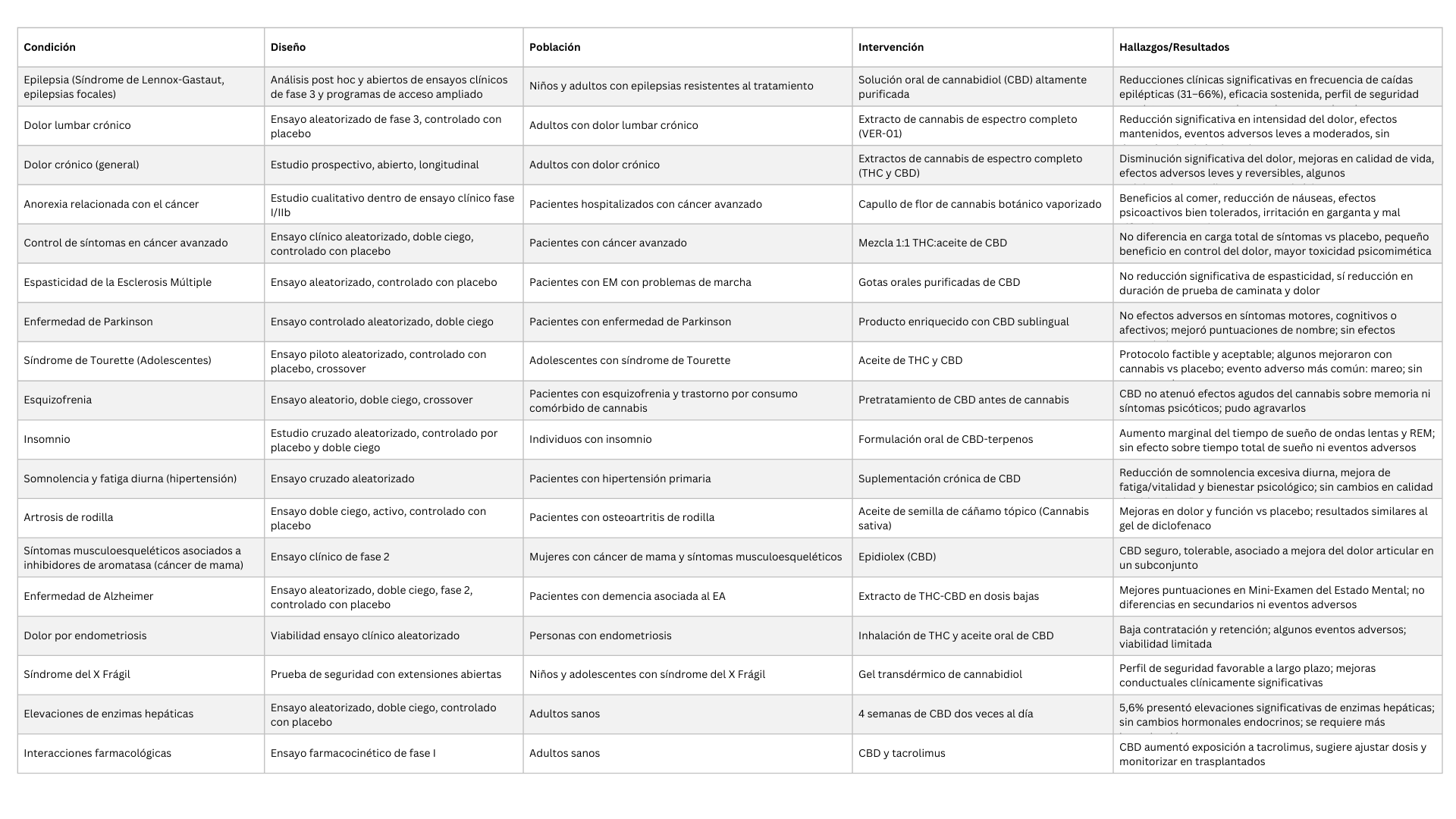
Ensayos clínicos indexados en Pubmed, publicados en 2025, que investigaron posibles efectos terapéuticos del cannabis o cannabinoides. Listado completo aquí
La seguridad y la farmacocinética son cada vez más centrales en el diseño de ensayos clínicos. Varios estudios examinan la biodisponibilidad entre formulaciones, las interacciones fármaco-fármaco (notablemente con el tacrolimus) y las elevaciones de enzimas hepáticas asociadas al uso de CBD. Aunque la mayoría de los efectos adversos son leves a moderados, estos hallazgos refuerzan que los cannabinoides no están exentos de riesgos y requieren el mismo rigor en el seguimiento que otros agentes farmacológicos.
La evidencia de estos estudios respalda de manera moderada la eficacia de los cannabinoides, especialmente el cannabidiol (CBD), en el tratamiento de ciertas formas de epilepsia. Además, se han observado resultados positivos en algunas condiciones de dolor crónico y, posiblemente, en el alivio de síntomas específicos asociados al cáncer, la esclerosis múltiple y otros trastornos poco frecuentes.
En cuanto a la seguridad, la mayoría de los estudios realizados señalan que los cannabinoides presentan un perfil seguro y bien tolerado. Sin embargo, no hay que perder de vista que también se han reportado algunos eventos adversos leves a moderados, así como la posibilidad de elevaciones en las enzimas hepáticas y la presencia de interacciones farmacológicas, aspectos que requieren una vigilancia rigurosa.
Por otro lado, los resultados de la investigación sobre el uso de cannabinoides en otras condiciones, como los trastornos del sueño, problemas psiquiátricos, espasticidad o la carga de síntomas en cáncer, son mixtos o presentan beneficios modestos. Esto pone de manifiesto la necesidad de seguir investigando para determinar con mayor precisión su eficacia en estos ámbitos.
En relación a la viabilidad y la aceptabilidad de las intervenciones con cannabinoides, la mayoría de los estudios consideran que son factibles y bien recibidas por los participantes. No obstante, existen poblaciones, como las personas con endometriosis, en las que se observan dificultades tanto en el reclutamiento como en la retención dentro de los ensayos clínicos, lo que representa un reto añadido para la investigación futura.
Estudios con resultados relevantes para la salud pública
A nivel poblacional, el trastorno por consumo de cannabis (CUD) sigue siendo una prioridad importante en la investigación. Los ensayos ponen a prueba una amplia gama de intervenciones —desde entrevistas motivacionales y prevención de recaídas basada en mindfulness hasta agentes farmacológicos y neuro modulación— a menudo con un enfoque en mecanismos de cambio como la preparación, estrategias conductuales protectoras y la influencia de los compañeros. Varios estudios se dirigen a jóvenes y poblaciones subrepresentadas, reflejando una creciente atención en esta población.
Por último, un subconjunto más pequeño pero importante de ensayos aborda la integración de políticas y sistemas sanitarios, incluyendo comparaciones entre mercados legales e ilícitos de cannabis y la implementación de cribado y tratamiento con cannabis en entornos de atención primaria. Estos estudios destacan cómo la legalización y la regulación se cruzan con los resultados en salud, la implicación en la atención y la reducción de daños.
En general, el último año de evidencia en ensayos clínicos dibuja un panorama de un campo en transición. La investigación sobre el cannabis ya no se limita únicamente a cuestiones de eficacia; cada vez más se enfrenta a temas de seguridad, equidad, implementación e impacto en el mundo real. Aunque existen pruebas sólidas para indicaciones seleccionadas —especialmente el CBD en ciertas epilepsias— varios de los usos propuestos muestran beneficios modestos o inconsistentes, lo que subraya la necesidad de continuar con ensayos clínicos rigurosos y bien diseñados y una política de salud pública reflexiva.
* hacer la búsqueda con el término “cannab*” en el título puede que no arroje todos los resultados de los ensayos clínicos que hayan usado cannabis, cannabinoides, y traten de temas relacionados con cannabis. Los resultados de esta búsqueda realizada para la escritura de este artículo no deben interpretarse como representativa de la totalidad de ensayos clínicos relacionados con cannabis y cannabinoides que pudieron haber sido indexados en Pubmed en el 2025
Listado de ensayos clínicos con “cannab*” en su título, indexados en PubMed en el 2025
1: Feibus I, Mahiques MB, Costello M, Potter K, Bentley KH, Hoeppner BB, Liu L, Evohr B, Yan L, Gilman J, Evins AE, Kossowsky J, Schuster RM. Characterizing proximal risk for depressive symptoms and suicidal ideation with acute cannabis use and withdrawal among adolescents using ecological momentary assessment: Study protocol. PLoS One. 2025 Dec 18;20(12):e0338790. doi: 10.1371/journal.pone.0338790. PMID: 41411314; PMCID: PMC12714289.
2: Pitel M, Phan O, Bonnaire C. Impact of the Kusa prevention program on cannabis consumption and emotional competencies among French Polynesian adolescents. Glob Health Promot. 2025 Dec;32(1_suppl):28-37. doi: 10.1177/17579759251317515. Epub 2025 Dec 15. PMID: 41396152.
3: Gilman JM, Cather C, Reeder HT, Evohr B, Pachas GN, Gray KM, McClure EA, Schuster RM, Evins AE. Cannabis Use and Nicotine Vaping Cessation Outcomes: A Secondary Analysis of a Randomized Clinical Trial. JAMA Netw Open. 2025 Dec 1;8(12):e2547799. doi: 10.1001/jamanetworkopen.2025.47799. PMID: 41385228; PMCID: PMC12701513.
4: Cardozo B, Hartley S, Simon N, Alvarez JC. Understanding cannabis use and car crashes: Insights from a randomized trial using a driving simulator on THC blood levels and subjective measures of sleepiness and performance. J Safety Res. 2025 Dec;95:109-116. doi: 10.1016/j.jsr.2025.09.005. Epub 2025 Sep 17. PMID: 41338767.
5: Liu J, Mi RZ, Jeon M, Fabbricatore JL, Wicke R, Cojulun LR, Yang S. Visual attention and memory retention of cannabis warning labels: an eye-tracking experiment with young adults. Ann Behav Med. 2025 Jan 4;59(1):kaaf094. doi: 10.1093/abm/kaaf094. PMID: 41338585.
6: Shi Y, Davies C, Wilson R, Appiah-Kusi E, Lythgoe DJ, Modinos G, Bhattacharyya S. A single dose of cannabidiol modulates the relationship between hippocampal glutamate and learning-related prefrontal activation in individuals at Clinical High Risk of Psychosis. Psychiatry Res Neuroimaging. 2026 Jan;355:112095. doi: 10.1016/j.pscychresns.2025.112095. Epub 2025 Nov 25. PMID: 41337954.
7: Darharaj M, Roshanpajouh M, Amini M, Shrier LA, Hamraz I, Habibi Asgarabad M. Effect of mobile-based ecological momentary motivational enhancement therapy on cannabis use temptation and dependence severity among Iranian young adults with cannabis use disorder: A randomized clinical trial. Drug Alcohol Depend. 2025 Dec 1;277:112957. doi: 10.1016/j.drugalcdep.2025.112957. Epub 2025 Nov 10. PMID: 41265235.
8: Berry-Kravis E, Hagerman R, Cohen J, Budimirovic D, Buchanan CB, Silove N, Tich N, Thibodeau A, Dobbins T, Sebree T, O'Quinn S, Albers DS, Bzdek KG, Nomikos G, Budur K. Long-term safety and tolerability of transdermal cannabidiol gel in children and adolescents with Fragile X syndrome (ZYN2-CL-017): an interim analysis of an ongoing open-label extension study. J Neurodev Disord. 2025 Nov 18;17(1):69. doi: 10.1186/s11689-025-09657-x. PMID: 41254489; PMCID: PMC12625530.
9: Kroon E, Elsey JWB, Kuhns LN, Rietveld P, De Vries O, Larsen H, Wiers RWHJ, Cousijn J. Back on track: Feasibility and efficacy randomized trial of a two- week online self-guided intervention for cannabis use reduction. Drug Alcohol Depend. 2025 Dec 1;277:112943. doi: 10.1016/j.drugalcdep.2025.112943. Epub 2025 Oct 29. PMID: 41192278.
10: Lorenzetti V, McTavish E, Thomson H, Clemente A, Rendell P, Terrett G, Greenwood LM, Freeman TP, Kamboj SK, Manning V. Brief mindfulness intervention for adults with cannabis use disorder: A randomised clinical trial. Drug Alcohol Depend. 2025 Dec 1;277:112909. doi: 10.1016/j.drugalcdep.2025.112909. Epub 2025 Oct 3. PMID: 41187669.
11: Graham AL, Cha S, Do EK, Jacobs MA, Edwards G, Papandonatos GD. Dual abstinence from nicotine vaping and cannabis use among young people: secondary analyses from two U.S.-based randomized controlled trials of vaping cessation. Subst Abuse Treat Prev Policy. 2025 Nov 3;20(1):48. doi: 10.1186/s13011-025-00679-1. PMID: 41177894; PMCID: PMC12581282.
12: Cury RM, da Silva T, Cezar-Dos-Santos F, Fakih YRC, Narvaez KAR, Gouvea MC, Espínola C, Ferreira CF, de Castro WAC, Pamplona FA, Silva EGD, Bicca MA, Nascimento FP. A randomized clinical trial of low-dose cannabis extract in Alzheimer's disease. J Alzheimers Dis. 2025 Dec;108(4):1602-1613. doi: 10.1177/13872877251389608. Epub 2025 Oct 29. PMID: 41160460.
13: Garey L, Jones AA, Nizio P, Chen TA, Buckner JD, Redmond BY, Businelle MS, Cheney MK, Obasi EM, Zvolensky MJ. Mobile intervention to address cannabis use disorder among black adults: A proof-of-concept randomized controlled trial. Behav Res Ther. 2025 Dec;195:104889. doi: 10.1016/j.brat.2025.104889. Epub 2025 Oct 14. PMID: 41109077.
14: Martino F, Ortiz-Peregrina S, Casares-López M, Granados-Delgado P, Castro- Torres JJ, Anera RG. Influence of Cannabidiol Use on Visual Function and Optical Quality: A Randomized Controlled Trial. Transl Vis Sci Technol. 2025 Oct 1;14(10):10. doi: 10.1167/tvst.14.10.10. PMID: 41071032; PMCID: PMC12524827.
15: Karst M, Meissner W, Sator S, Keßler J, Schoder V, Häuser W. Full-spectrum extract from Cannabis sativa DKJ127 for chronic low back pain: a phase 3 randomized placebo-controlled trial. Nat Med. 2025 Dec;31(12):4189-4196. doi: 10.1038/s41591-025-03977-0. Epub 2025 Sep 29. PMID: 41023483; PMCID: PMC12705446.
16: Chesterman S, Mikocka-Walus A, Sinclair J, Druitt M, Furyk J, Evans S, Abbott J, Eathorne A, Martin A, Ng C, Nguyen L, Oldfield K, Romano D, Sarris J, Semprini A, Stanley K, Armour M. Challenges in conducting a feasibility randomized controlled trial of medicinal cannabis for endometriosis pain in Australia. Complement Ther Clin Pract. 2025 Nov;61:102023. doi: 10.1016/j.ctcp.2025.102023. Epub 2025 Sep 23. PMID: 41005282.
17: Matson TE, Johnson E, Bobb JF, Graham VF, Kiel LM, Lee AK, Lapham GT, Caldeiro RM, Bradley KA, Angerhofer JE. Implementing Care for Cannabis and Other Drug Use in Adult Primary Care: Outcomes of a Cluster-Randomized Implementation Trial. Am J Prev Med. 2026 Jan;70(1):108112. doi: 10.1016/j.amepre.2025.108112. Epub 2025 Sep 16. PMID: 40967380; PMCID: PMC12462408.
18: Strickland JC, Tilton HE, Patton NM, Vandrey R, Austin Zamarripa C, Spindle TR, Lee DC, Bergeria CL, Wolinsky D, Klawitter J, Sempio C, Campos-Palomino J, Christians U, Feldner MT, Irons JG, Bonn-Miller MO. Effect of caffeine and cannabidiol (CBD) co-administration on Δ9-tetrahydrocannabinol (Δ9-THC) subjective effects, performance impairment, and pharmacokinetics. Neuropsychopharmacology. 2025 Nov;50(12):1827-1835. doi: 10.1038/s41386-025-02232-x. Epub 2025 Sep 17. PMID: 40962814; PMCID: PMC12518643.
19: Richardson KE, Suo C, Albertella L, Maleki S, Coxon J, Hendrikse J, Hughes S, Pitt J, Kayayan E, Brown C, Nguyen L, Solowij N, Lubman DI, Segrave R, Yücel M. High-Intensity Exercise and Hippocampal Integrity in Adults With Cannabis Use Disorder: A Randomized Clinical Trial. JAMA Psychiatry. 2025 Dec 1;82(12):1240-1245. doi: 10.1001/jamapsychiatry.2025.2319. PMID: 40928796; PMCID: PMC12423954.
20: Gillham SH, Cole PL, Owens DJ, Chester N, Bampouras TM, McCartney D, Gordon R, McGregor IS, Close GL. Daily Use of a Broad-Spectrum Cannabidiol Supplement Produces Detectable Concentrations of Cannabinoids in Urine Prohibited by the World Anti-Doping Agency: An Effect Amplified by Exercise. Med Sci Sports Exerc. 2026 Jan 1;58(1):121-131. doi: 10.1249/MSS.0000000000003842. Epub 2025 Sep 8. PMID: 40920736.
21: Martin-Willett R, Skrzynski CJ, Bryan AD, Bidwell LC. Effects of Cannabinoids on Emotional States and Alcohol Use Among Underrepresented Groups: Moderation by Perceived Discrimination. Hum Psychopharmacol. 2025 Sep;40(5):e70016. doi: 10.1002/hup.70016. PMID: 40916181.
22: Luckett T, Razmovski-Naumovski V, Garcia M, Phillips J, Chye R, Noble B, Fazekas B, Martin J, Agar M; Cannabinoids for Cancer Symptoms Research Group (CCSRG). Benefits and Burdens of Vaporized Botanical Cannabis Flower Bud for Cancer-Related Anorexia: A Qualitative Study of the Experiences of People with Advanced Cancer Enrolled as Inpatients in a Phase I/IIb Clinical Trial and Their Family Carers. J Palliat Med. 2025 Sep;28(9):1246-1250. doi: 10.1177/10966218251372439. Epub 2025 Aug 28. PMID: 40865547.
23: Colonna R, Tucker P, Mandich A, Alvarez L. Using intervention mapping to evaluate 'High-Alert,' a brief smartphone intervention to reduce youth cannabis- impaired driving. PLoS One. 2025 Aug 22;20(8):e0329383. doi: 10.1371/journal.pone.0329383. PMID: 40845142; PMCID: PMC12373201.
24: Bergeria CL, Mun CJ, Speed TJ, Huhn AS, Wolinsky D, Vandrey R, Campbell CM, Dunn KE. A within-subject, double-blind, placebo-controlled randomized evaluation of the combined effects of cannabidiol and hydromorphone in a human laboratory pain model. Pain. 2025 Feb 28;166(9):e175-e184. doi: 10.1097/j.pain.0000000000003561. PMID: 40839659; PMCID: PMC12353022.
25: Piper ME, Kaye JT, Piasecki TM, Yang JJ, Buu A. Cannabis use among adults who smoke tobacco: Relations with switching from combusted cigarettes to e-cigarettes or very low nicotine cigarettes. Drug Alcohol Depend. 2025 Oct 1;275:112821. doi: 10.1016/j.drugalcdep.2025.112821. Epub 2025 Aug 6. PMID: 40803048.
26: Specchio N, Auvin S, Greco T, Lagae L, Nortvedt C, Zuberi SM. Clinically Meaningful Reduction in Drop Seizures in Patients with Lennox-Gastaut Syndrome Treated with Cannabidiol: Post Hoc Analysis of Phase 3 Clinical Trials. CNS Drugs. 2025 Oct;39(10):1025-1036. doi: 10.1007/s40263-025-01201-8. Epub 2025 Aug 7. PMID: 40775196; PMCID: PMC12423233.
27: Fleege NMG, Miller EA, Kidwell KM, Zacharias ZR, Houtman J, Scheu K, Kemmer K, Boehnke KF, Henry NL. Pilot Study of Cannabidiol for Treatment of Aromatase Inhibitor-Associated Musculoskeletal Symptoms in Breast Cancer. Cancer Med. 2025 Aug;14(15):e71117. doi: 10.1002/cam4.71117. PMID: 40751295; PMCID: PMC12316815.
28: Massey ZB, Tong C, Zhang T, Wexell KH, Li Y, Zhao J. Assessing Responses to Cannabis Health Warnings Among Adults in U.S. Recreational States. Am J Prev Med. 2025 Nov;69(5):107998. doi: 10.1016/j.amepre.2025.107998. Epub 2025 Jul 25. PMID: 40716688.
29: Hardy JR, Greer RM, Pelecanos AM, Huggett GE, Kearney AM, Gurgenci TH, Good PD. Medicinal cannabis for symptom control in advanced cancer: a double-blind, placebo-controlled, randomised clinical trial of 1:1 tetrahydrocannabinol and cannabidiol. Support Care Cancer. 2025 Jul 24;33(8):715. doi: 10.1007/s00520-025-09763-5. PMID: 40705150; PMCID: PMC12289739.
30: Chesney E, Oliver D, Sarma A, Lamper AD, Slimani I, Lloyd M, Dickens AM, Welds M, Kråkström M, Gasparini-Andre I, Orešič M, Lawn W, Babayeva N, Freeman TP, Englund A, Strang J, McGuire P. Does cannabidiol reduce the adverse effects of cannabis in schizophrenia? A randomised, double-blind, cross-over trial. Neuropsychopharmacology. 2025 Nov;50(12):1759-1767. doi: 10.1038/s41386-025-02175-3. Epub 2025 Jul 24. PMID: 40702165; PMCID: PMC12518716.
31: Patel AD, Szaflarski JP, Lyons PD, Boffa M, Greco T, Saurer TB, Rajasekaran K, Simontacchi KC, Thiele EA. Long-term efficacy and safety of cannabidiol in patients with treatment-resistant focal epilepsies treated in the Expanded Access Program. Epilepsia. 2025 Oct;66(10):3730-3740. doi: 10.1111/epi.18496. Epub 2025 Jul 17. PMID: 40673944; PMCID: PMC12605695.
32: Rabin RA, Lerman C, Schnoll R, Tyndale RF, George TP. A multi-site study examining the tobacco withdrawal trajectory in people with tobacco and cannabis co-use. Drug Alcohol Depend. 2025 Sep 1;274:112778. doi: 10.1016/j.drugalcdep.2025.112778. Epub 2025 Jul 3. PMID: 40633181.
33: Florian J, Salcedo P, Burkhart K, Shah A, Chekka LMS, Keshishi D, Patel V, Yang S, Fein M, DePalma R, Matta M, Strauss DG, Rouse R. Cannabidiol and Liver Enzyme Level Elevations in Healthy Adults: A Randomized Clinical Trial. JAMA Intern Med. 2025 Sep 1;185(9):1070-1078. doi: 10.1001/jamainternmed.2025.2366. Erratum in: JAMA Intern Med. 2025 Sep 1;185(9):1179. doi: 10.1001/jamainternmed.2025.4537. PMID: 40622698; PMCID: PMC12235532.
34: Haney M, Choo TH, Tiersten A, Levin FR, Grassetti A, DeSilva N, Arout CA, Martinez D. Oral Cannabis for Taxane-Induced Neuropathy: A Pilot Randomized Placebo-Controlled Study. Cannabis Cannabinoid Res. 2025 Oct;10(5):631-639. doi: 10.1089/can.2025.0028. Epub 2025 Jul 4. PMID: 40611810.
35: Hurzeler T, DeMayo M, Logge W, Watt J, McGregor IS, Suraev A, Haber P, Morley K. The effect of cannabidiol on neurometabolite levels in alcohol use disorder. Alcohol Alcohol. 2025 May 14;60(4):agaf029. doi: 10.1093/alcalc/agaf029. PMID: 40551671.
36: Narayan AJ, Manning B, Aitken B, Downey LA, Hayley AC. Same-Day Sedative and Night-Time Sleep Effects Following Combined Cannabinoid Formulations: A Randomised-Controlled Trial. Clin Drug Investig. 2025 Jul;45(7):417-429. doi: 10.1007/s40261-025-01455-6. Epub 2025 Jun 21. PMID: 40542913; PMCID: PMC12255549.
37: F A, M L, G B, R GJ, S K, I M. Effectiveness of Full Spectrum Cannabis Extracts in the Treatment of Chronic Pain: An Open Label Study. J Pain Palliat Care Pharmacother. 2025 Sep;39(3):346-352. doi: 10.1080/15360288.2025.2517778. Epub 2025 Jun 17. PMID: 40526158.
38: Kirkland AE, Browning BD, Meredith LR, Robertson E, Herring C, Tomko RL, Gray KM, Squeglia LM. The neural and psychophysiological effects of cannabidiol in youth with alcohol use disorder: A randomized controlled clinical trial. Neuropsychopharmacology. 2025 Sep;50(10):1482-1492. doi: 10.1038/s41386-025-02141-z. Epub 2025 Jun 11. PMID: 40500407; PMCID: PMC12339998.
39: Mousavi P, Emadzadeh M, Karimikhoshnoudian B, Sahraian MA, Ghaffari M, Shaygannejad V, Payere M, Baghaei A, Zabeti A, Nahayati M. A randomized trial on efficacy of purified cannabidiol on spasticity in multiple sclerosis patients with gait problems: first report in Iran. Naunyn Schmiedebergs Arch Pharmacol. 2025 Dec;398(12):17435-17444. doi: 10.1007/s00210-025-04347-w. Epub 2025 Jun 11. PMID: 40498097.
40: Mbogo GW, Kroner P, Walsh R, Newchurch J, Bleackley MR. An open-label phase I comparator-controlled clinical trial to assess tolerability and pharmacokinetics of IHL-675 A a fixed dose combination of cannabidiol plus hydroxychloroquine in healthy volunteers. Sci Rep. 2025 Jun 3;15(1):19357. doi: 10.1038/s41598-025-04573-5. PMID: 40456820; PMCID: PMC12130181.
41: Coronado-Montoya S, Abdel-Baki A, Bodson-Clermont P, Boucher-Roy D, Côté J, Crocker CE, Crockford D, Daneault JG, Dubreucq S, Dussault-Laurendeau M, Fischer B, Lachance-Touchette P, Lecomte T, L'Heureux S, Ouellet-Plamondon C, Roy MA, Tatar O, Tibbo PG, Villeneuve M, Wittevrongel A, Jutras-Aswad D. A pilot randomized controlled trial of a digital cannabis harm reduction intervention for young adults with first-episode psychosis who use cannabis. Psychiatry Res. 2025 Aug;350:116553. doi: 10.1016/j.psychres.2025.116553. Epub 2025 May 17. PMID: 40450961.
42: Kassim FM, Davey AJW, Tod S, Rodger J, Albrecht MA, Martin-Iverson MT. The effect of a synthetic cannabinoid agonist (nabilone) on unimodal tactile illusion correlates with a psychometric scores in healthy volunteers. Sci Rep. 2025 May 27;15(1):18469. doi: 10.1038/s41598-025-02280-9. PMID: 40425618; PMCID: PMC12116753.
43: West NE, Konstan MW, Flume PA, VanDevanter DR, Magaret A, Mazurek H, Amelina EL, Laki I, Chiron R, Sutharsan S, Columbo C, Dorkin HL, Downey DG, Sole A, Hjelte L, Tullis E, Dgetluck N, Dinh Q, Constantine S, White B, Elborn JS, Chmiel JF; JBT101-CF-002 Study Group. Cannabinoid receptor 2 agonist, lenabasum, for the treatment of pulmonary exacerbations in cystic fibrosis. J Cyst Fibros. 2025 Jul;24(4):691-697. doi: 10.1016/j.jcf.2025.03.015. Epub 2025 May 26. PMID: 40425421.
44: Mason MJ, Coatsworth JD, Russell MA, Mennis J, Riggs NR, Zaharakis N, Brown A. Young Adults Advancing Through the Stages of Change: A Mediational Analysis of Cannabis Use Disorder Treatment. Subst Use Misuse. 2025;60(10):1523-1529. doi: 10.1080/10826084.2025.2505767. Epub 2025 May 18. PMID: 40383939; PMCID: PMC12213214.
45: Pilloni G, Pehel S, Ko T, Sammarco C, Charlson RE, Hanlon CA, Charvet L. Telehealth tDCS to reduce cannabis use: A pilot RCT in multiple sclerosis as a framework for generalized use. Drug Alcohol Depend. 2025 Jul 1;272:112706. doi: 10.1016/j.drugalcdep.2025.112706. Epub 2025 May 15. PMID: 40378662; PMCID: PMC12160002.
46: Baltes-Flueckiger L, Steinauer R, Meyer M, Guessoum A, Herrmann O, Mosandl CF, Kronschnabel J, Pichler EM, Vogel M, Walter M. Effects of legal access versus illegal market cannabis on use and mental health: A randomized controlled trial. Addiction. 2025 Oct;120(10):1982-1992. doi: 10.1111/add.70080. Epub 2025 Apr 28. PMID: 40289676; PMCID: PMC12426350.
47: Llanes KD, Amastae J, Amrhein PC, Lisha N, Arteaga K, Lopez E, Moran RA, Cohn LD. Impact of Computer-Mediated Versus Face-to-Face Motivational-Type Interviews on Participants' Language and Subsequent Cannabis Use: Randomized Controlled Trial. J Med Internet Res. 2025 Apr 25;27:e59085. doi: 10.2196/59085. PMID: 40279644; PMCID: PMC12064966.
48: Mitarnun W, Kanjanarangsichai A, Junlaor P, Kongngern L, Mitarnun W, Pangwong W, Nonghan P. Cannabidiol and cognitive functions/inflammatory markers in Parkinson's disease: A double-blind randomized controlled trial at Buriram Hospital (CBD-PD-BRH trial). Parkinsonism Relat Disord. 2025 Jun;135:107841. doi: 10.1016/j.parkreldis.2025.107841. Epub 2025 Apr 16. PMID: 40267585.
49: Longardner K, Shen Q, Castellanos FX, Tang B, Gandhi R, Wright BA, Momper JD, Nahab FB. Double-Blind, Randomized, Placebo-Controlled, Crossover Study of Oral Cannabidiol and Tetrahydrocannabinol for Essential Tremor. Tremor Other Hyperkinet Mov (N Y). 2025 Apr 14;15:14. doi: 10.5334/tohm.1005. PMID: 40248111; PMCID: PMC12005140.
50: Kuntzman Y, Halpert G, Amital H. Cannabidiol and Its Effects on Patients with COVID-19 Infection. Isr Med Assoc J. 2025 Feb;27(2):78-81. PMID: 40170643.
51: Reuter SE, Schultz HB, McLachlan AJ, Henson JD, Vitetta L. Pharmacokinetics and Bioavailability of Cannabinoids Administered via a Novel Orobuccal Nanoparticle Formulation (NanoCelle™) in Patients with Advanced Cancer. Cannabis Cannabinoid Res. 2025 Dec;10(6):691-701. doi: 10.1089/can.2024.0117. Epub 2025 Mar 25. PMID: 40130357.
52: Hurzeler T, Logge W, Watt J, McGregor IS, Suraev A, Haber PS, Morley KC. Cannabidiol attenuates precuneus activation during appetitive cue exposure in individuals with alcohol use disorder. Eur Arch Psychiatry Clin Neurosci. 2025 Oct;275(7):2129-2139. doi: 10.1007/s00406-025-01983-4. Epub 2025 Mar 18. PMID: 40102270; PMCID: PMC12589260.
53: Efron D, Taylor K, Chan E, Payne JM, Prakash C, Lee KJ, Cranswick N, Lin PD, Eapen V. A Pilot Randomized Placebo-Controlled Crossover Trial of Medicinal Cannabis in Adolescents with Tourette Syndrome. Cannabis Cannabinoid Res. 2025 Dec;10(6):702-709. doi: 10.1089/can.2024.0188. Epub 2025 Mar 17. PMID: 40082070.
54: Meda SA, Stevens MC, Boer ER, Pittman B, Gueorguieva R, Huestis MA, Pearlson GD. A randomized, placebo-controlled, double-blind, pilot study of cannabis- related driving impairment assessed by driving simulator and self-report. J Psychopharmacol. 2025 Apr;39(4):364-372. doi: 10.1177/02698811251324379. Epub 2025 Mar 12. PMID: 40077985.
55: Nielsen RL, Bornæs O, Christensen LWS, Juul-Larsen HG, Storgaard IK, Kallemose T, Jørgensen LM, Jawad BN, Altintas I, Lund TM, Rasmussen HH, Munk T, Andersen O, Houlind MB, Andersen AL. The appetite stimulating effect and safety of delta-9-tetrahydrocannabinol (THC) and cannabidiol (CBD) in older patients with poor appetite: A triple-blinded, randomized, placebo-controlled, cross-over trial. Clin Nutr. 2025 Apr;47:248-257. doi: 10.1016/j.clnu.2025.02.024. Epub 2025 Feb 24. PMID: 40069983.
56: Elder HJ, Zamarripa CA, Klausner M, Wakshlag J, Davis R, Dresser B, Kjaer C, Weerts EM, Vandrey R, Spindle TR. The Pharmacokinetics and Pharmacodynamics of a Hemp-Derived "Full-Spectrum" Oral Cannabinoid Product with a 1:1 Ratio of Cannabidiol to Cannabidiolic Acid and Delta-9-Tetrahydrocannabinol to Delta-9-Tetrahydrocannabinolic Acid: A Double-Blind, Placebo-Controlled, Within- Subjects Human Laboratory Study. Cannabis Cannabinoid Res. 2025 Apr;10(2):e299-e313. doi: 10.1089/can.2024.0187. Epub 2025 Mar 5. PMID: 40040421.
57: Lambart LM, Cox LS, Mayo MS, Brown AR, Leavens ELS, Ahluwalia JS, Nollen NL. Change in Cigarette, Other Tobacco Product, and Cannabis Use Among Individuals Who Used or Did Not Use Cannabis During a Smoking Cessation Trial. Nicotine Tob Res. 2025 Aug 22;27(9):1641-1646. doi: 10.1093/ntr/ntaf045. PMID: 39976595; PMCID: PMC12370467.
58: Pélerin JM, Gegout T, Schwitzer T, Schwan R, Albuisson E, Gédor M, Laprévote V, Bourgognon F. Mindfulness-based relapse prevention for cannabis regular users: Finally outcomes of a randomized clinical trial. Encephale. 2025 Oct;51(5):519-525. doi: 10.1016/j.encep.2024.11.014. Epub 2025 Feb 7. PMID: 39922725.
59: Gray KM, Tomko RL, Baker NL, McClure EA, McRae-Clark AL, Squeglia LM. N-acetylcysteine for youth cannabis use disorder: randomized controlled trial main findings. Neuropsychopharmacology. 2025 Apr;50(5):731-738. doi: 10.1038/s41386-025-02061-y. Epub 2025 Feb 5. PMID: 39910268; PMCID: PMC11914066.
60: Shulman M, Choo TH, Ohrtman K, Pavlicova M, Rotrosen J, Nunes EV. Effects of randomization to buprenorphine or naltrexone for OUD on cannabis use outcomes: A secondary analysis of the X:BOT trial. Drug Alcohol Depend. 2025 Mar 1;268:112550. doi: 10.1016/j.drugalcdep.2025.112550. Epub 2025 Jan 18. PMID: 39892089; PMCID: PMC11832313.
61: Saals BADF, De Bie TH, Osmanoglou E, van de Laar T, Tuin AW, van Orten- Luiten ACB, Witkamp RF. A high-fat meal significantly impacts the bioavailability and biphasic absorption of cannabidiol (CBD) from a CBD-rich extract in men and women. Sci Rep. 2025 Jan 29;15(1):3678. doi: 10.1038/s41598-025-87621-4. PMID: 39880884; PMCID: PMC11779803.
62: Ortiz-Peregrina S, Martino F, Casares-López M, Granados-Delgado P, Anera RG, Castro Torres JJ. Visual function and vehicle driving performance under the effects of cannabidiol: A randomized cross-over experiment. Addiction. 2025 May;120(5):975-983. doi: 10.1111/add.16746. Epub 2025 Jan 6. PMID: 39760163; PMCID: PMC11986291.
63: Mason MJ, Coatsworth JD, Riggs NR, Russell M, Mennis J, Zaharakis N, Brown A. Text message-delivered cannabis use disorder treatment with young adults: A large randomized clinical trial. J Subst Use Addict Treat. 2025 Mar;170:209611. doi: 10.1016/j.josat.2024.209611. Epub 2024 Dec 25. PMID: 39730041; PMCID: PMC11885044.
64: Chauhan D, Ghosh A, Naik SS, Rana DK, Singh SM. Acceptability, Feasibility, and Effectiveness of Concurrent High-Definition Transcranial Direct Current Stimulation and Cue Exposure in Cannabis Use Disorder: A Pilot Double-Blind Randomized Controlled Trial. J ECT. 2025 Jun 1;41(2):126-135. doi: 10.1097/YCT.0000000000001087. Epub 2024 Dec 24. PMID: 39718389.
65: Chung AKK, Tse CY, Yeung GKY, Tang SW, Chan WM, Law JKC. Vortioxetine improves illness severity for cannabis users with anxiety and depressive symptoms in a 6-month randomized controlled study. J Subst Use Addict Treat. 2025 Feb;169:209607. doi: 10.1016/j.josat.2024.209607. Epub 2024 Dec 12. PMID: 39672338.
66: Zimmermann S, Teetzmann A, Baeßler J, Schreckenberger L, Zaiser J, Pfisterer M, Stenger M, Bach P. Acute cannabidiol administration reduces alcohol craving and cue-induced nucleus accumbens activation in individuals with alcohol use disorder: the double-blind randomized controlled ICONIC trial. Mol Psychiatry. 2025 Jun;30(6):2612-2619. doi: 10.1038/s41380-024-02869-y. Epub 2024 Dec 12. PMID: 39668256; PMCID: PMC12092268.
67: Arout CA, Harris HM, Wilson NM, Mastropietro KF, Bozorgi AM, Fazilov G, Tempero J, Walker M, Haney M. A Preliminary Pharmacokinetic Comparison of Δ-9 Tetrahydrocannabinol and Cannabidiol Extract Versus Oromucosal Spray in Healthy Men and Women. Cannabis Cannabinoid Res. 2025 Jun;10(3):457-466. doi: 10.1089/can.2023.0249. Epub 2024 Dec 9. PMID: 39648730.
68: Isenmann E, Lachenmeier DW, Flenker U, Lesch A, Veit S, Diel P. Short-term repeated oral intake of low dose cannabidiol: effects on liver enzyme activity and creatinine concentration during intense exercise. Arch Toxicol. 2025 Feb;99(2):815-824. doi: 10.1007/s00204-024-03904-1. Epub 2024 Dec 4. PMID: 39630203.
69: Stefanović M, Osredkar D, Rener-Primec Z, Peterlin J, Laptoš T, Neubauer D. Plant-derived cannabinoids for treatment of spasticity in children and adolescents with severe cerebral palsy: Double-blind, placebo-controlled trial. Eur J Paediatr Neurol. 2025 Jan;54:18-24. doi: 10.1016/j.ejpn.2024.11.007. Epub 2024 Nov 26. PMID: 39626543.
70: So GC, Lu JBL, Koyama S, Cheng YH, Gisch DL, McClara K, Dexter PR, Sharfuddin AA, Etkins J, Tillman EM, Beamon TR, Cowsert Z, Stuart JS, Desta Z, Eadon MT. A Phase I Trial of the Pharmacokinetic Interaction Between Cannabidiol and Tacrolimus. Clin Pharmacol Ther. 2025 Mar;117(3):716-723. doi: 10.1002/cpt.3504. Epub 2024 Nov 27. PMID: 39601108; PMCID: PMC11835423.
71: Stone CJ, Ahuja G, Lopes Almeida Gomes L, Poroye J, Faden DF, Xie L, Feng R, White B, Werth VP. Long-Term Safety and Efficacy of Lenabasum, a Cannabinoid Receptor Type 2 Agonist, in Patients with Dermatomyositis with Refractory Skin Disease: Follow-Up Data from a 3-Year Open-Label Extension Study. JID Innov. 2024 Sep 5;5(1):100311. doi: 10.1016/j.xjidi.2024.100311. PMID: 39403556; PMCID: PMC11472610.
72: Brown T, Kruse C, Schmitt R, Gaffney G, Milavetz G. Assessing the impact of cannabis use on freeway driving performance and practices: A comparative analysis with placebo and alcohol-influenced driving. Traffic Inj Prev. 2025;26(1):10-19. doi: 10.1080/15389588.2024.2393215. Epub 2024 Sep 20. PMID: 39303060.
73: Johnson DA, Cable TG, Funnell MP, Peden DL, Thorley J, Ferreira DA Cunha M, Reynolds KM, Harris L, Wood M, Chavez-O'Reilly T, Carrington J, Bailey SJ, Clifford T, Heaney LM, James LJ. Effects of Cannabidiol Ingestion on Thermoregulatory and Inflammatory Responses to Treadmill Exercise in the Heat in Recreationally Active Males. Med Sci Sports Exerc. 2025 Feb 1;57(2):413-424. doi: 10.1249/MSS.0000000000003568. Epub 2024 Sep 19. PMID: 39294920.
74: Abbasifard M, Moosavi Z, Azimi M, Kamiab Z, Bazmandegan G, Madahian A, Raeiszadeh M. Effect of Topical Hemp (Cannabis sativa L.) Seed Oil on Knee Osteoarthritis: A Randomized Double-Blind Controlled Trial. Pain Manag Nurs. 2025 Feb;26(1):e74-e81. doi: 10.1016/j.pmn.2024.08.001. Epub 2024 Sep 10. PMID: 39256070.
75: Dujic G, Kumric M, Vrdoljak J, Sutlovic D, Dujic Z, Bozic J. Chronic Cannabidiol Administration Mitigates Excessive Daytime Sleepiness and Fatigue in Patients with Primary Hypertension: Insights from a Randomized Crossover Trial. Cannabis Cannabinoid Res. 2025 Aug;10(4):549-557. doi: 10.1089/can.2024.0028. Epub 2024 Aug 26. PMID: 39187263.
76: Wang M, Faust M, Abbott S, Patel V, Chang E, Clark JI, Stella N, Muchowski PJ. Effects of a cannabidiol/terpene formulation on sleep in individuals with insomnia: a double-blind, placebo-controlled, randomized, crossover study. J Clin Sleep Med. 2025 Jan 1;21(1):69-80. doi: 10.5664/jcsm.11324. PMID: 39167421; PMCID: PMC11701282.
77: Narayan AJ, Hayley AC, Rose S, Di Natale L, Downey LA. The effect of nightly use of 150 mg cannabidiol on daytime neurocognitive performance in primary insomnia: a randomized controlled pilot trial. Psychopharmacology (Berl). 2025 Feb;242(2):297-308. doi: 10.1007/s00213-024-06674-x. Epub 2024 Aug 17. PMID: 39153080; PMCID: PMC11774964.
78: Kittithamvongs P, Anantasinkul P, Siripoonyothai S, Anantavorasakul N, Malungpaishrope K, Uerpairojkit C, Leechavengvongs S. Does Cannabis-based Medicine Improve Pain and Sleep Quality in Patients With Traumatic Brachial Plexus Injuries? A Triple-blind, Crossover, Randomized Controlled Trial. Clin Orthop Relat Res. 2025 Feb 1;483(2):228-234. doi: 10.1097/CORR.0000000000003221. Epub 2024 Aug 6. PMID: 39115545; PMCID: PMC11753724.
79: Pastina JT, Abel MG, Bollinger LM, Best SA. Topical Cannabidiol Application May Not Attenuate Muscle Soreness or Improve Performance: A Randomized, Double- Blinded, Placebo-Controlled Pilot Study. Cannabis Cannabinoid Res. 2025 Jun;10(3):445-456. doi: 10.1089/can.2024.0012. Epub 2024 Jul 9. PMID: 38980809.
80: Powlowski P, Matheson J, Le Foll B, Andreazza AC, Ross RA. Acute Cannabis Administration Transiently Reduces Mitochondrial DNA in Young Adults: Findings from a Secondary Analysis of a Double-Blind, Placebo-Controlled, Randomized Clinical Trial. Cannabis Cannabinoid Res. 2025 Apr;10(2):e314-e322. doi: 10.1089/can.2023.0282. Epub 2024 Jun 26. PMID: 38923954.
81: Brunette MF, Roth RM, Trask C, Khokhar JY, Ford JC, Park SH, Hickey SM, Zeffiro T, Xie H. Randomized Laboratory Study of Single-Dose Cannabis, Dronabinol, and Placebo in Patients With Schizophrenia and Cannabis Use Disorder. Schizophr Bull. 2025 Mar 14;51(2):479-492. doi: 10.1093/schbul/sbae097. PMID: 38900958; PMCID: PMC11908874.
82: Hebert FO, Mongeau-Pérusse V, Rizkallah E, Mahroug A, Bakouni H, Morissette F, Brissette S, Bruneau J, Dubreucq S, Jutras-Aswad D. Absence of Evidence for Sustained Effects of Daily Cannabidiol Administration on Anandamide Plasma Concentration in Individuals with Cocaine Use Disorder: Exploratory Findings from a Randomized Controlled Trial. Cannabis Cannabinoid Res. 2025 Apr;10(2):e341-e352. doi: 10.1089/can.2023.0273. Epub 2024 May 21. PMID: 38770686.
83: Tarlovski S, Bar Kadmon A, Goldberg E, Segal D, Gavish D, Stepensky D. Comparative Pharmacokinetic Assessment of Innovative Sublingual, Rectal and Vaporizer Cannabis Products Versus Approved Cannabis Products in Healthy Volunteers. Cannabis Cannabinoid Res. 2025 Apr;10(2):e289-e298. doi: 10.1089/can.2023.0229. Epub 2024 Apr 24. PMID: 38656906.
84: Chen MY, Kramer EB, Gibson LP, Bidwell LC, Hutchison KE, Bryan AD. Investigating the Relationship Between Cannabis Expectancies and Anxiety, Depression, and Pain Responses After Acute Flower and Edible Cannabis Use. Cannabis Cannabinoid Res. 2025 Feb;10(1):71-80. doi: 10.1089/can.2023.0264. Epub 2024 Apr 12. PMID: 38608236; PMCID: PMC12344119.
85: Leen-Feldner EW, Bynion TM, Eglit GML, Bonn-Miller MO, Gournay LR, Feldner MT. A double-blind, randomized, placebo-controlled test of the effects of cannabidiol on fear elicited by a 10% carbon dioxide-enriched air breathing challenge. Psychopharmacology (Berl). 2025 Jul;242(7):1515-1527. doi: 10.1007/s00213-022-06258-7. Epub 2022 Oct 15. PMID: 36241853.